
China has become a major sourcing destination for global buyers seeking reliable Party Decoration suppliers. Its factories offer balloons, banners, tableware, backdrops, paper fans, and themed accessories in many styles. Buyers can often compare materials, colors, packaging, and production capacity within one supply chain.
Experienced importers know that attractive samples are only one part of a successful order. A dependable supplier should provide clear product specifications, stable quality control, accurate lead times, and export-ready packaging. For example, a buyer may request flame-resistant materials where appropriate, strong carton protection, and color consistency across thousands of printed banners. Factory audits, sample approval, and third-party inspections can reduce avoidable surprises.
Details matter.
This guide introduces China’s top Party Decoration suppliers for global buyers. It focuses on practical sourcing signals, including manufacturing experience, customization ability, communication quality, certifications, and after-sales support. Supplier information should still be verified carefully. Online claims can become outdated, and a polished catalog does not always reflect current production standards. That is an important limitation.
Buyers should also consider order quantities, shipping routes, seasonal demand, and destination-market requirements. A low unit price may lose its advantage when packaging is weak or delivery is late. Reliable cooperation usually develops through written specifications, realistic timelines, and consistent communication. With careful evaluation, global buyers can build safer, more efficient, and more professional Party Decoration supply chains from China.
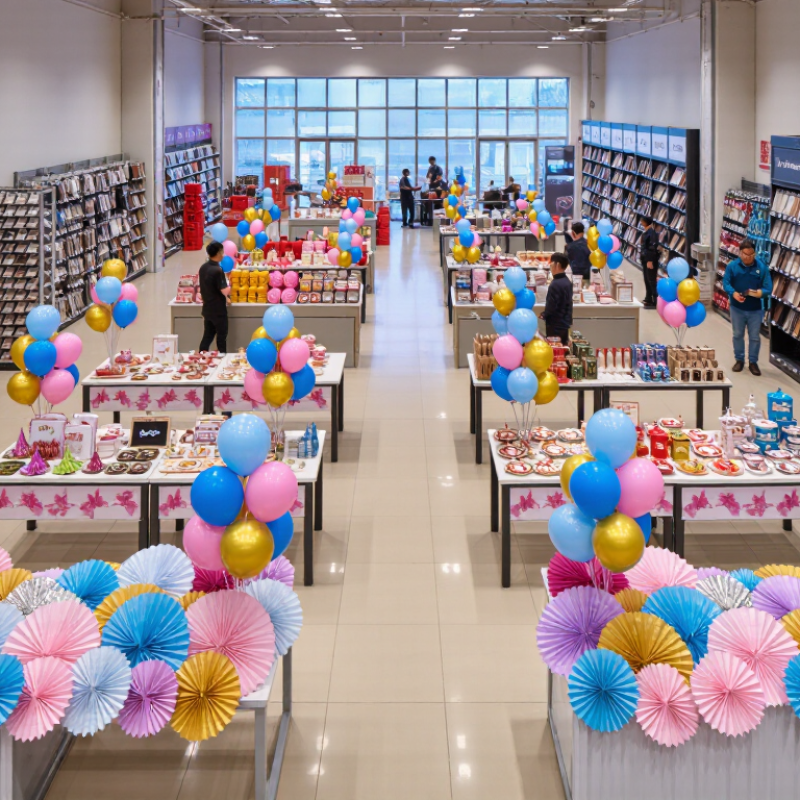
China’s party decoration suppliers generally fall into four practical categories.
Specialized factories produce balloons, banners, tableware, backdrops, and seasonal accessories at scale.
OEM factories can adjust colors, packaging, materials, and printing for private-label orders. Their minimum order quantities may be high.
Trading companies offer broader catalogs and simpler communication. They often combine products from several factories, which helps buyers build themed collections. However, product consistency needs checking.
Wholesale markets provide fast access to ready-made decorations, especially for smaller trial orders. Custom workshops focus on event backdrops, paper structures, and unusual shapes. They suit creative projects but usually require longer sampling periods.
China’s General Administration of Customs reported cross-border e-commerce exports of approximately RMB 1.83 trillion in 2023. This growth supports more supplier choices, but it also increases comparison work. Grand View Research estimates the global party supplies market will continue expanding through 2030, driven by personalized events and online purchasing. The figure is useful, though market definitions differ between reports. That limitation matters.
Tips: Request material specifications, carton dimensions, test samples, and recent production photos. Compare defect rates, not only prices. A cheap sample may hide weak seams or uneven printing. I would also verify recycled-content claims through documents, because supplier descriptions can be incomplete. Start with a modest order. Mistakes become expensive when every decoration shares the same defect.
Reliable party decoration suppliers usually provide balloons, paper banners, table centerpieces, photo backdrops, hanging ornaments, and themed gift bags. Product quality depends on material thickness, color consistency, printing accuracy, and secure packaging. Buyers should request clear specifications, including dimensions, weight, carton details, and suggested use conditions. For children’s events, suppliers should also provide relevant safety information and testing documents required by the destination market.
Customization can include logos, color palettes, shapes, patterns, packaging, and complete event themes. Digital artwork should be checked carefully before production. A small sample may reveal weak adhesive, dull printing, or mismatched colors. That step is easy to skip. It should not be. Experienced suppliers can support sample approval, production inspection, and shipment planning. However, buyers still need independent checks. A polished catalog does not guarantee consistent bulk quality.
Tips: Send vector artwork, exact measurements, and color references. Ask for a pre-production sample. Confirm material composition and packaging strength. Discuss minimum order quantities and realistic lead times. Leave extra time for revisions. Perfection on the first sample is uncommon, and that is worth planning for.
China Top Party Decoration Suppliers for Global Buyers
How to Evaluate Chinese Decoration Suppliers
Choosing reliable Chinese party decoration suppliers requires more than comparing online prices. Global buyers should inspect materials, production control, and communication habits. Request samples before discussing large orders. Check foil thickness, print clarity, seam strength, color consistency, and packaging. Small details matter. Ask whether the supplier performs batch inspections and keeps inspection records. A clear answer shows process maturity, not just sales confidence. Verify business registration, export experience, and relevant product test documents independently. Do not treat a copied certificate as proof of current quality. Good suppliers explain limits honestly.
Tips: Visit the factory by video or in person when possible. Watch how workers store materials and separate finished goods. Request a written specification sheet covering dimensions, materials, tolerances, carton counts, and delivery terms. Confirm the production schedule in writing. For seasonal events, late cartons can damage the entire campaign. Use a pre-shipment inspection with agreed sampling rules. I would also test one small order first. It costs more attention, but exposes weak packing, unclear labeling, or slow responses early. No checklist is perfect.
Professional evaluation includes commercial reliability. Compare payment terms, minimum order quantities, replacement policies, and response times. Ask for references from comparable overseas projects, while respecting confidentiality. A supplier may offer attractive decorations but lack capacity during peak months. Discuss backup production, quality claims, and shipping coordination before signing. Keep every approved sample and specification in a shared record. This prevents memory-based disputes. I still leave room for doubt. Reliable sourcing improves when evidence outweighs promises.
| Evaluation Dimension | Practical Reference Benchmark | Evidence to Request and Verify | Common Buyer Risk | Suggested Weight |
|---|---|---|---|---|
| Factory Legitimacy | The supplier should provide a valid business registration record, consistent company information, and a verifiable production or office address. | Request the business license, registered address, company bank-account details, export history, factory video, and a live video inspection. | Trading-company information may be presented as factory capability; ownership and production location may be unclear. | 12% |
| Product Compliance and Safety | Products intended for the United States or European Union should be reviewed against the destination market’s rules for chemicals, flammability, labeling, and children’s product safety where applicable. | Request recent third-party test reports, material declarations, safety data sheets, product specifications, and batch traceability records. | A report may cover a different material, color, model, or production batch than the goods being ordered. | 16% |
| Material Transparency | The supplier should identify the main material, coating, adhesive, dye, metal component, and packaging material used in each product. | Compare the material declaration with the sample, bill of materials, test report, and product packaging. Confirm whether recycled or flame-retardant claims are documented. | Undisclosed material substitutions can affect appearance, durability, odor, safety, and customs classification. | 10% |
| Quality Management | A documented quality system should define incoming-material inspection, in-process checks, final inspection, defect classification, and corrective action. | Ask for inspection checklists, acceptable quality limit criteria, defect photos, calibration records, and sample quality reports from previous orders. | Visual quality may vary between the approved sample and mass production if inspection standards are not written. | 14% |
| Production Capacity | Capacity should be assessed against the buyer’s required quantity, peak-season schedule, product mix, and packaging workload rather than a single monthly figure. | Request a capacity plan showing production lines, key equipment, staffing, subcontracting arrangements, daily output, and current order loading. | Decorative products often have seasonal demand, and capacity may be reduced before major holidays or during peak export periods. | 10% |
| Minimum Order Quantity | MOQ should be evaluated separately for standard items, customized items, printed packaging, special colors, and new molds or tooling. | Obtain a written MOQ schedule and confirm whether mixed colors, mixed designs, or mixed stock-keeping units can be combined in one order. | A low quoted MOQ may exclude custom packaging, special materials, color changes, or separate artwork setup charges. | 6% |
| Sampling and Customization | A professional supplier should provide a pre-production sample or approval sample before bulk manufacturing of customized products. | Confirm sample cost, sample lead time, artwork format, color approval method, revision policy, tooling ownership, and written sample sign-off procedures. | Color, dimensions, print position, glitter distribution, or assembly details may differ from digital artwork. | 8% |
| Lead Time and Delivery Reliability | The quotation should separate sample lead time, production lead time, packaging lead time, and estimated transit time. | Request a production schedule, shipment history, on-time delivery records, holiday closure dates, and a written delay-escalation process. | Quoted production time may not include artwork approval, material procurement, inspection, rework, or port congestion. | 8% |
| Packaging and Carton Efficiency | Packaging should protect fragile or shape-sensitive decorations while keeping carton dimensions, gross weight, and volumetric freight under control. | Review carton specifications, inner-pack method, drop-test or transit-test results where relevant, palletization, shipping marks, and loading photos. | Insufficient protection can cause breakage; excessive packaging can increase freight cost and storage requirements. | 6% |
| Export Documentation | Commercial invoices, packing lists, transport documents, country-of-origin information, and product-specific certificates should match the actual shipment. | Ask for a sample document set, customs classification support, carton count controls, and confirmation of the export entity shown on shipping documents. | Inconsistent descriptions, quantities, values, or tariff classifications may cause customs delays or additional costs. | 5% |
| Ethical and Environmental Controls | Buyers should assess labor practices, waste handling, chemical management, energy use, and the traceability of sustainability claims. | Request social or environmental audit reports, waste-disposal records, material certifications where claimed, and a supplier code of conduct. | Unverified recycled-content, ethical-production, or environmental claims can create regulatory and reputational exposure. | 5% |
| Commercial Terms and Buyer Protection | The quotation should clearly state product specifications, Incoterms, payment stages, tooling charges, inspection rights, claims procedure, and replacement or refund terms. | Compare the proforma invoice with the quotation, confirm payment-account ownership, define acceptance criteria, and use an independent pre-shipment inspection when appropriate. | Ambiguous terms make it difficult to recover costs for shortages, defects, late delivery, or unauthorized specification changes. | 10% |
Reliable party decoration suppliers begin with controlled manufacturing, not attractive catalog photos. Experienced factories inspect paper, PVC, fabric, and adhesive materials before production. Cutting machines must maintain accurate shapes and clean edges. For banners and hanging ornaments, workers check hole positions, printing color, and stitching strength. Small details matter.
Quality control should continue throughout the order. Inspectors compare samples with approved specifications, including size, weight, color, and packaging quantity. Random carton checks can reveal crushed corners, missing accessories, or mixed designs. Moisture-resistant packing helps protect products during long sea transport. However, no inspection system is perfect. A supplier may still miss a minor color difference between batches, especially under different lighting.
Export service requires more than loading cartons. Professional teams prepare commercial invoices, packing lists, carton marks, and shipping information accurately. They should explain production schedules and report delays before they become expensive problems. Clear communication reduces misunderstandings about quantities, customs requirements, and delivery terms. Buyers can request pre-shipment photos and independent inspections when order value is high. Good suppliers accept these checks without defensiveness. That attitude builds trust.
China Top Party Decoration Suppliers for Global Buyers
Ordering party decorations from China requires more than comparing unit prices. Request a detailed quotation with materials, dimensions, colors, packaging, and minimum order quantities. Ask whether the supplier can provide product samples before bulk production. Samples reveal loose parts, weak printing, and color differences. Small details matter. Confirm production times in writing, especially before seasonal events. A low quote may exclude inner cartons, inspection fees, or export packaging.
Shipping decisions should match the product’s volume and urgency. Sea freight usually suits large orders, while air freight supports tight event schedules. Request carton dimensions, gross weight, loading quantity, and estimated departure dates. These figures help your forwarder calculate realistic costs. Confirm the agreed Incoterm and delivery destination carefully. Port congestion and holiday closures can change schedules. Some estimates remain imperfect, so keep a buffer of at least two weeks.
Import preparation protects the shipment from avoidable delays. Check the correct HS codes, duties, taxes, labeling rules, and destination-country safety requirements. Your customs broker should review the documents before departure. Common paperwork includes the commercial invoice, packing list, transport document, and certificate of origin when required. Consider a pre-shipment inspection with photos of cartons, labels, and finished goods. Decorations may look simple, but fragile surfaces and mixed assortments need careful handling. Rechecking everything feels slow, yet one missing document can cost more than the inspection.
Specialized factories produce balloons, banners, tableware, backdrops, and seasonal accessories. Trading companies offer wider catalogs. Custom workshops handle unusual shapes and event structures.
Factories suit larger orders and deeper customization. Trading companies simplify communication and combine products from several sources. Wholesale markets support quick, smaller trials. Product consistency still needs checking.
Common options include colors, shapes, patterns, packaging, logos, and complete event themes. Send vector artwork, exact measurements, and color references. A small sample may expose dull printing or weak adhesive.
Check material thickness, color consistency, printing accuracy, seams, and packaging strength. Request carton dimensions, product weight, and material composition. Cheap samples can hide fragile parts. That lesson is easy to miss.
Ask for material specifications, test samples, production photos, and safety documents for the destination market. Confirm minimum order quantities and lead times in writing. Recycled-content claims should have supporting documents. Descriptions can be incomplete.
Sea freight usually suits large, less urgent shipments. Air freight works better for tight event schedules. Request carton size, gross weight, loading quantity, and departure estimates. Keep at least two extra weeks.
Check HS codes, duties, taxes, labeling rules, and destination-country safety requirements. A customs broker should review documents before departure. Typical paperwork includes invoices, packing lists, transport documents, and certificates of origin when required.
Start with a modest quantity and approve a pre-production sample. Use an independent inspection before shipment when practical. Photograph cartons, labels, and finished goods. I might still overlook something. Rechecking is worthwhile.
China offers a wide range of Party Decoration suppliers for global buyers, including manufacturers, wholesale distributors, trading companies, and specialized custom-production workshops. Their product selections may include balloons, banners, tableware, backdrops, paper decorations, lighting accessories, and themed event sets. Many suppliers support customization through color matching, printed designs, packaging, shapes, sizes, and coordinated collections, allowing buyers to develop decorations for birthdays, weddings, festivals, corporate events, and other celebrations.
When evaluating suppliers, buyers should review product quality, material safety, production capacity, customization experience, communication, certifications, and sample performance. Reliable suppliers normally provide clear quotations, quality-control procedures, inspection support, and export documentation. Buyers should also confirm minimum order quantities, production schedules, payment terms, packaging standards, shipping methods, and import requirements before placing an order. Careful planning and verification can help reduce risks, control costs, and ensure that Party Decoration products arrive safely, consistently, and in compliance with the destination market’s applicable regulations.
